Second Thought About First Thought Hurts More
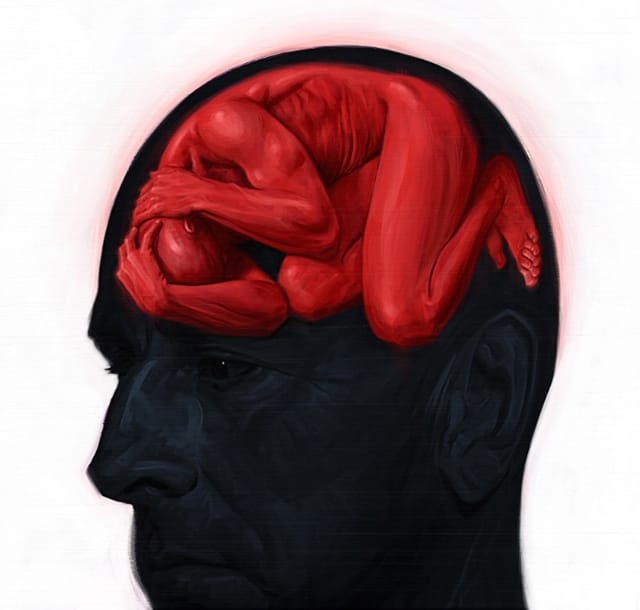
What if the first thought is innocent, and the real bully is the inner commentator doing a live roast?

I have this peculiar habit of coming up with “why” questions no matter where I go or what I do.
Even in the shower, I think, “Why is the flow going this way and not that way?” Sorry, I can’t help it. It is what it is. I am just being honest.
Yes, I like asking questions, but all the time? No way, that’s too much! Sometimes, before going to sleep, I beg my mind to stop “producing” questions, at least for now, and let me sleep. But it won’t budge.
Today it dawned on me: it is not the first thought—“Why XYZ?”—that troubles me the most, but the second thought about the first thought.
For example, the exact questions that came to my mind were:
- “Why am I troubled by these ‘why’ questions popping up?”
- “What is inherently wrong with these questions coming up at weird times?”
If it is the nature of the brain or mind to come up with questions (why, what, or how), then why am I so troubled by what the brain is doing? Why can’t I let it do what it is built to do or supposed to do?
When the heart’s function is to beat and pump blood, and the liver’s function is to filter blood, why am I so irritated by what the brain is doing? After all, it is performing its function, assigned by evolution, right?
So why am I irritated? What exactly am I irritated at?
That’s when it dawned on me (another thought): the automatic response (another thought) that says, “Aman, you are so weird! Who thinks such a ‘why’ question in the shower?” or something like, “Aman, it’s time you get your act together and get rid of this bad habit!”
These almost automatic responses that come up after the first questioning thought are the real troublemakers.
Now, let us go a little more deeply into the nature of these automatic responses.
Are these responses—nothing but more thoughts—built in by evolution, or are they conditioned from childhood?
That is to say, is it the nature of the mind to come up with responses to its own stimulus? Usually, we say, “Because I crashed my car into the pole, that’s why I am angry.” That is, something happened externally (stimulus), which produced a response in the brain (anger).
But here, the brain produced a thought internally (the “why” question), to which it is replying itself (“You are so weird”). Is this natural, or is it learned?
Think about it.
Maybe the brain will come up with some answer (one more thought!).
P.S. The brain said that a thought is a thought. One could be evolutionary, and another could be conditioned, but still, a thought—like hair is hair, whether black or white.
When the heart’s function is to beat and pump blood, and the liver’s function is to filter blood, why am I so irritated by what the brain is doing? After all, it is performing its function, assigned by evolution, right?
What about you?
Maybe you don’t have “why” questions in the shower.
Maybe your mind attacks you somewhere else.
On the bed at night: “Why did I say that in the meeting?” “Why am I like this?” “Why can’t I just stop thinking?”
The first thought is usually simple: “I talked too much.” “I forgot that message.” “I wish I was calmer.”
The sting comes from the second thought: “There you go again, messing things up.” “Normal people don’t do this. What’s wrong with you?”
That’s the jump: from observation to character assassination.
What if the first thought is innocent, and the real bully is the inner commentator doing a live roast?
Next time a “weird” thought appears, in the shower, metro, toilet, or at 2:37 a.m., try this:
Don’t fight the first thought. Watch the second.
Can you catch the line that says, “You’re weird, broken, failing at being an adult,” and see it as conditioning, not truth?
Then gently ask, “Whose side am I on here: my aliveness or my inner critic?”
The heart beats. The liver filters. The brain questions.
Maybe the point is not to fix the questions, but to stop punishing the questioner.
What is one “weird” pattern of your mind that you secretly judge?
What happens if, for one day, you watch it with affection instead of aggression?